
How spreads change during news events
Reading time: 9 minutes
If you've been following the markets for a while, you may have noticed how the release of the US Non-Farm Payroll (NFP) report impacts the forex markets. The effect isn’t just limited to the US dollar strengthening or weakening; spreads can quickly change immediately after the data is released. The same situation can occur if the Federal Reserve (Fed) decides to hold interest rates steady when the market expects a rate cut.
This policy shift could lead to currency pairs reacting aggressively to unexpected economic data. Even a minor miss in an inflation or employment report might reset global market expectations instantly. This, in turn, could affect liquidity access almost instantly, even in a market with massive trading volumes. A sudden decline in liquidity is one of the key reasons why forex spreads widen during high-impact news events.
Why spreads widen during major news breaks
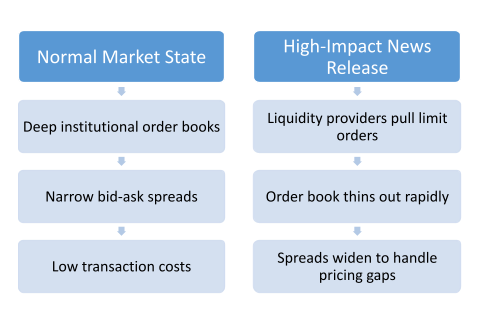
Major currency pairs, like the EUR/USD, USD/JPY or GBP/USD, usually see tight, predictable spreads under normal market conditions. Liquidity providers, such as top-tier banks and market makers, constantly compete for your transaction, keeping the bid-ask spread narrow, sometimes even hovering near zero pips on raw accounts. However, this pricing stability depends entirely on the constant, uninterrupted presence of these institutional market makers.
Now, an economic release that differs from market expectations or an unexpected news break, such as the closure of the Strait of Hormuz disrupting global oil supply chains, can cause an immediate gap in currency valuations. This means liquidity providers (LPs) are exposed to financial risk. To protect their own balance sheets from getting caught on the wrong side of an aggressive market move, some LPs may reduce available liquidity, widen their quotes, or pull some of their resting limit orders from order books a fraction of a second before the news drops. This defensive action changes the liquidity landscape completely.
When these orders disappear, market depth can thin dramatically. If your broker operates an Electronic Communication Network (ECN) or a Straight-Through Processing (STP) model, their matching engine will need to cross your trade with the next best available price. When the nearest orders are removed, the gap between the best available bid and the best available ask expands rapidly, which could lead a spread that normally sits at 0.3 pips to widen to 5, 10, or even 20 pips within a few milliseconds.
How widening forex spreads impact execution and trading costs
Wider spreads don’t just increase your baseline transaction fees but can also affect the speed of order execution, directly affecting how your orders fill.
Slippage in low-liquidity markets
When you use a standard market order during a major news release, you instruct your broker to fill your position immediately at the best available price. While trading a major news event, the ‘best available price’ can sometimes change faster than your platform can update. If the order book is thin, your order may be filled at a worse price level than you saw on your screen. This difference, known as slippage, can raise your trading costs.
Phantom stop-loss triggers
This can be a very frustrating experience. You may have placed your stop-loss order after careful analysis. But during extreme news-related price swings, the spread might widen suddenly. Now, if you hold a long position and the bid price drops sharply due to a wider spread, even if the underlying chart’s mid-market price never touches your technical line, the widened spread can trigger your stop loss, closing your position earlier than anticipated.
Requotes and execution delays
If you trade with a broker that uses fixed spreads or a dealing-desk model, you may face frequent requotes during high-impact news events. This is because the platform cannot find an internal match for your trade at your requested price because the broader market is moving too quickly. The result is costly delays during critical market moves.
Major news events that can widen spreads
Not all economic announcements cause the same level of market disruption. It is important to monitor the economic calendar while trading the news to stay prepared for high-impact data releases that could lead to market volatility.
Central bank interest rate decisions
Announcements by the Federal Reserve (Fed), European Central Bank (ECB) and Bank of England (BoE) are closely followed by forex traders. Changes in monetary policy expectations and forward guidance can trigger significant market volatility.
Inflation data
This includes the Consumer Price Index (CPI) and Producer Price Index (PPI) data releases. When a CPI report reveals a surprise jump or drop that misses expectations, automated trading systems get into action. They scramble to revalue currencies in a matter of milliseconds. This sudden, chaotic scrambling can pull immediate liquidity out of the market, causing spreads to balloon across every related major pair.
Employment reports
The US Non-Farm Payrolls (NFP) report, released on the first Friday of every month, reflects the health of the world’s largest economy. This single report can set the tone for global market sentiment, generating some of the biggest spread spikes in major pairs due to the sheer volume of automated trades that hit the market at the same time.
How to navigate widening spreads in forex trading
Here are some strategies experienced traders use during high-impact news events.
The five-minute rule
Perhaps, the simplest way to handle widening spreads is to avoid them entirely. Some experienced traders prefer not to open new positions five minutes before or five minutes after a top-tier news release. They let the initial wave of algorithmic orders clear out of the matching engines, wait for institutional liquidity providers to re-enter the order book, and then execute their positions once spreads return to their baseline levels.
Switching to pending limit orders
Market orders can leave you vulnerable to slippage. Limit orders give you greater control over your execution price. With a limit order, if the market thins out and cannot hit your exact number, the platform simply leaves your order unfilled. This way, you might miss the move, but you also avoid slippage and additional trading costs.
Adding a spread buffer to stop-loss orders
If you hold trades through major data releases, you could see temporary spread spikes. Instead of placing their stop loss right on a standard support or resistance line, experienced traders tend to add a safety buffer based on how that specific currency pair actually behaves during news releases. For instance, if a pair's spread typically widens by 6 pips during CPI reports, you could place your stop loss 8 to 10 pips beyond your technical line. This adjustment could help prevent temporary spread widening from knocking you out of a trade prematurely.
Adapting to changing market conditions
Managing spread widening in forex trading comes down to understanding how market liquidity changes during major news breaks. By keeping track of high-impact news releases on your economic calendar, using limit orders instead of market orders and building safety cushions into your stop losses, you can be better positioned to protect your account from unnecessary trading costs. Also, trading forex via Contracts for Difference (CFDs) is a popular choice during news breaks as they allow you to speculate on both rising and falling prices.
To gain confidence while trading the news in a fast-moving market, you need a platform that combines robust trading tools with complete transparency. At FP Markets, we provide an execution ecosystem tailored to handle changing market conditions. Our platforms connect you directly to deep, multi-source liquidity networks, aiming to provide low-latency execution and competitive spreads even during volatile market periods. Open an account with FP Markets today and start exploring the world of trading.
Frequently asked questions (FAQs)
Spreads widen because some institutional liquidity providers may pull their resting orders out of the market right before a major news event to protect themselves from risk. When these orders are removed, the order book thins out, leading to wider price gaps between the best available buy and sell prices.
Yes. Most standard trading charts plot the mid-market price or the bid price by default. If you are in a long position, your trade is likely to close at the active bid price. If a news event causes the spread to expand, the bid price might drop sharply enough to hit your stop loss, even if the main candle line on your chart appears to stay above it.
For major currency pairs, spreads usually stabilise and return to their normal baseline levels within two to five minutes after the news release. However, for minor or exotic pairs that normally tend to see lower liquidity, spreads can remain elevated for 15 minutes or longer as market makers wait for the initial wave of volatility to settle.